







Summarize With AI


Psychological safety at work is the shared belief that you won't be punished, ignored, or embarrassed for speaking up, asking a question, or admitting an error. It's the single biggest factor separating teams that catch problems early from teams that hide them, and it's a big reason We360.ai, which tracks workload and burnout signals for over 10,000 companies, gets asked so often how HR teams can spot it before an exit interview does.
What is psychological safety at work?
What is psychological safety? Psychological safety is a shared belief among a group that it's safe to take interpersonal risks, like asking a question, admitting a mistake, or challenging an idea, without being shamed or punished for it. Harvard Business School professor Amy Edmondson introduced the term in a 1999 paper, Psychological Safety and Learning Behavior in Work Teams, after studying hospital teams that reported more errors, not fewer, because they trusted each other enough to talk about them.
It's easy to confuse psychological safety with being nice. It isn't. A psychologically safe team still argues, still gives blunt feedback, and still holds people accountable. The difference is that criticism targets the work, not the person, and nobody gets punished later for having spoken up in the meeting.
Google tested this directly. Its People Analytics team spent two years studying 180 internal teams under a project code-named Aristotle, looking for what made some teams consistently outperform others with the same skills and resources. The answer wasn't who was on the team. It was how the team treated each other, and psychological safety came out on top of all five dynamics measured, ahead of dependability, structure, meaning, and impact, per Google's own writeup.
Why it matters
Psychological safety matters because it's the strongest predictor Google has found for whether a team performs well, and losing it costs real people, not just ideas. Teams with strong psychological safety are less likely to lose staff, more likely to surface useful disagreement, and rated as effective roughly twice as often by their own executives, according to Google's internal data.
The retention numbers are the clearest evidence. In BCG's 28,000-person study, only 3% of employees with high psychological safety said they were likely to quit within a year, compared with 12% of employees with the lowest levels, a fourfold gap. The same employees reported being 2.1 times more motivated, 2.7 times happier, and 3.3 times more likely to say they could reach their full potential at work when psychological safety was high.
That effect isn't distributed evenly. BCG found that when psychological safety improves, retention gains are largest for the employees most likely to have felt excluded before: fourfold for women and BIPOC employees, fivefold for people with disabilities, and sixfold for LGBTQ+ employees, versus a twofold gain for men outside those groups. In plain terms, psychological safety does the most good for the people who had the least of it to begin with.
Psychological safety examples
Psychological safety shows up in small, ordinary moments, not in a mission statement. Here's what it actually looks like on a team that has it:
- A junior employee asks "can you explain that acronym" in a leadership meeting, and nobody sighs.
- Someone flags a bug they introduced before it's discovered in a bad way, and the conversation stays focused on the fix.
- A manager says "I got that wrong, here's what I'm changing" in front of the team.
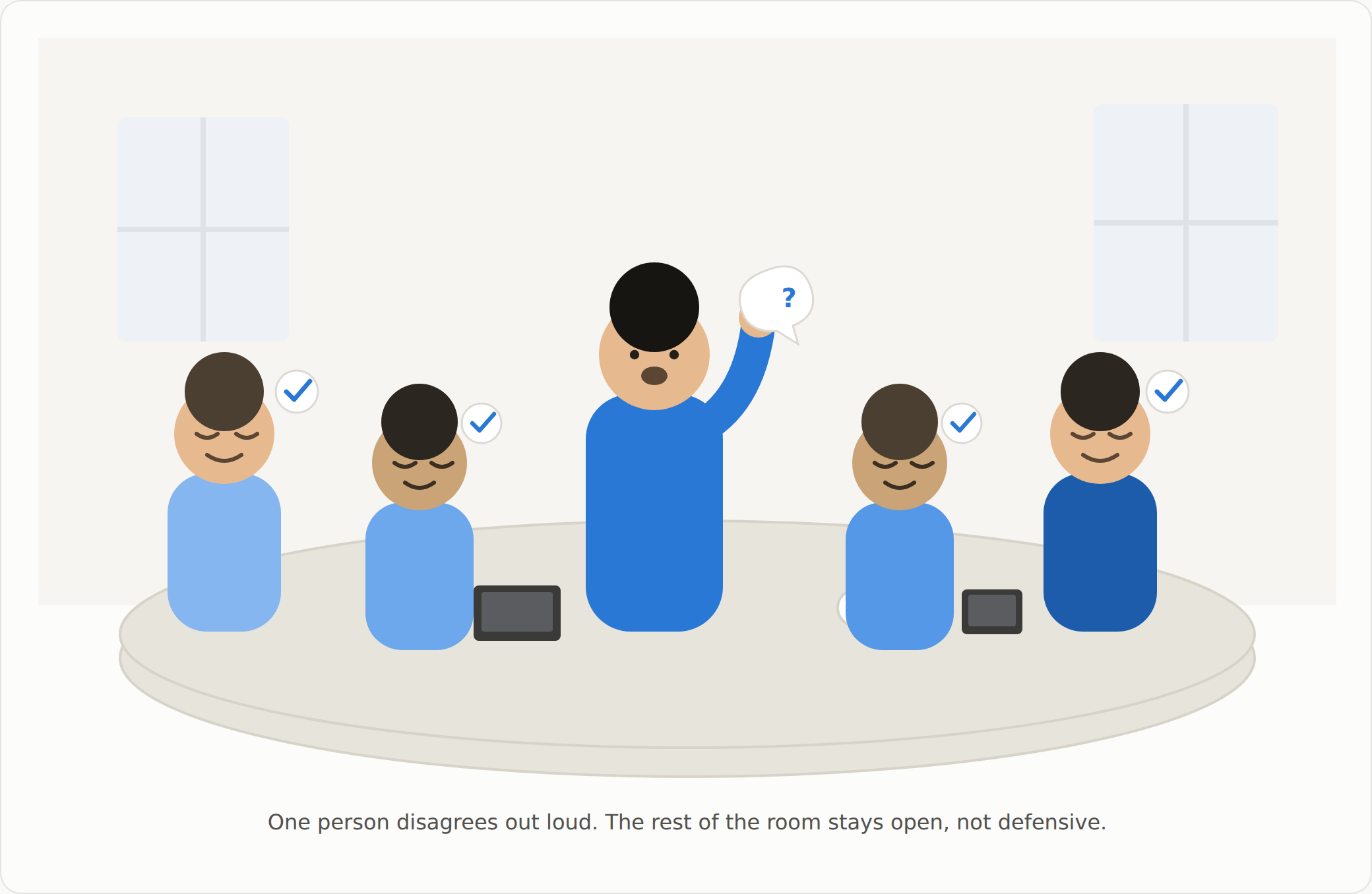
- A quiet team member disagrees with the loudest person in the room, and the idea gets discussed on its merits.
- Someone takes a mental health day without inventing a cover story.
- New hires get asked for their honest first impressions in week one, and something on that list actually changes.
None of these require a big program. They require a manager who doesn't punish the behavior when it happens, consistently, for months.
How to create psychological safety at work
You create psychological safety at work by changing how leaders respond to bad news, not by adding a values poster. The fastest, cheapest ways to improve psychological safety at work all live in how a manager reacts in the first ten seconds after someone says something risky.
- React to mistakes with curiosity, not blame. Ask "what happened" before "whose fault is this." The first question invites detail; the second shuts it down.
- Model it from the top first. A manager who admits a wrong call in front of the team gives everyone else permission to do the same.
- Separate the idea from the person in feedback. Critique the plan, the deck, or the code, not the person who made it.
- Ask better questions in meetings. "What am I missing?" gets a different answer than "any objections?"
- Close the loop on feedback. If someone raises a concern and nothing visibly changes, they won't raise the next one.
- Watch for the quiet warning signs. A drop in meeting participation or a spike in after-hours work often shows up before anyone says a word about feeling unsafe.
If you want a way to track that last point instead of guessing, this is where workforce analytics helps. We360.ai's workforce analytics surfaces workload spikes and after-hours patterns that tend to show up before a team's psychological safety drops, so a manager isn't only relying on a once-a-year survey to find out.
What to do when there's no psychological safety at work
If there's no psychological safety at work on your team, start by naming the specific behavior, not the vague feeling, and raise it with someone who can act on it. "I stopped bringing up problems after the last one got me blamed in front of the team" is something a manager or HR partner can actually respond to; "the culture feels bad" usually isn't.
A few concrete moves help when you're the one who feels unsafe:
- Document the pattern. One bad meeting is a bad day. Three similar incidents over two months is a pattern worth raising.
- Pick your audience carefully. Go to whoever has the standing to change the behavior, whether that's your manager's manager, HR, or a skip-level.
- Start with your own team first. Psychological safety is often local to a manager, not universal across a company. A move to a different team can fix it without changing employers.
- Know it's not just you. Research on this topic consistently finds that people in low-safety environments underreport problems for months before anything visible breaks, which is exactly why the early warning signs of burnout are worth learning before an exit interview becomes the first signal.
If nothing changes after you've raised it clearly and given it real time, that's information too. Chronic low psychological safety is one of the stronger predictors behind voluntary employee attrition, and it's reasonable to factor that into whether the team, or the company, is worth staying at.
Psychological safety training
Psychological safety training works when it changes specific manager behaviors, and fails when it stays a one-time workshop with no follow-up. The strongest programs combine a shared framework, practiced skills, and a way to check whether anything actually changed three months later.
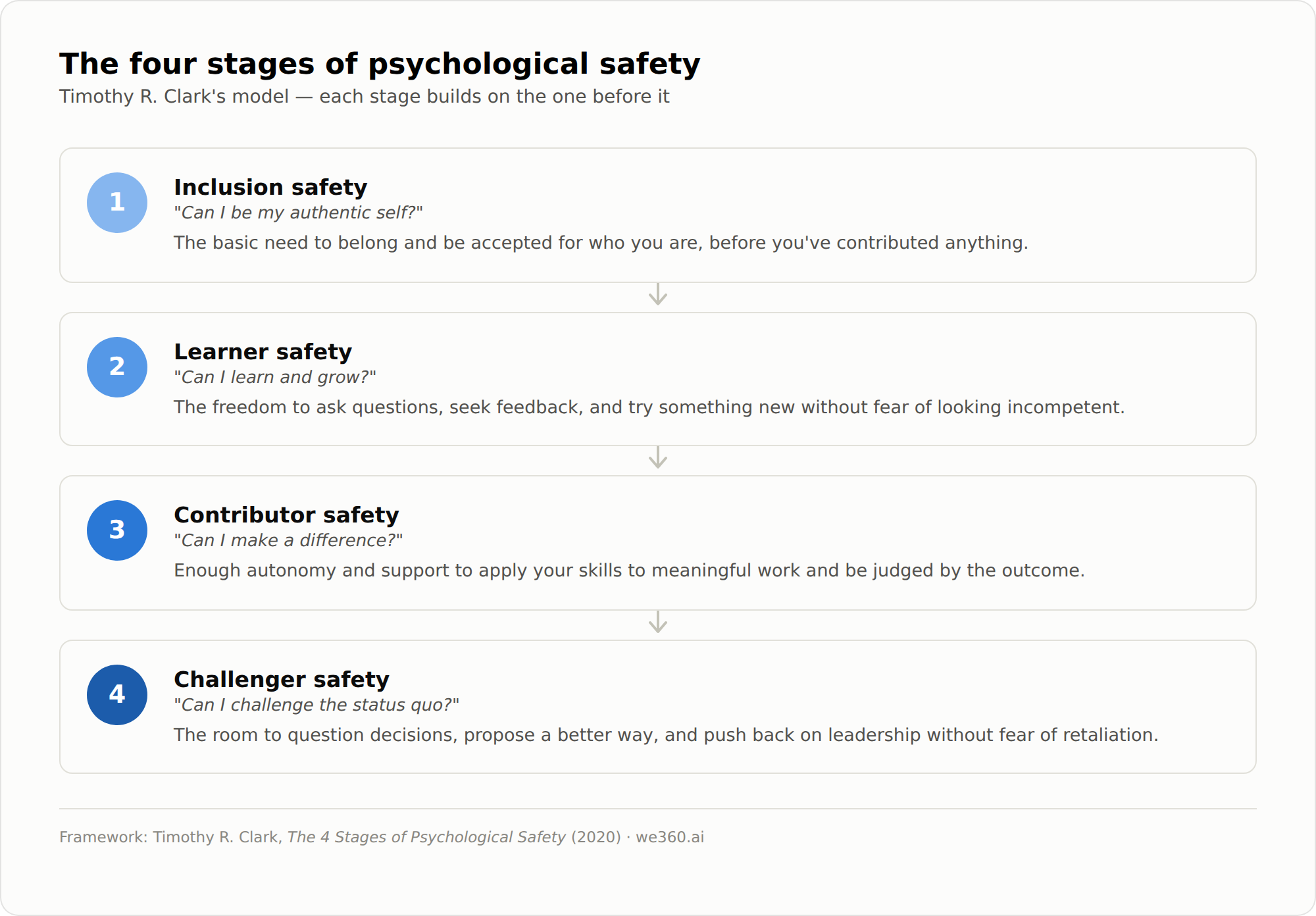
Two frameworks show up most often in serious programs. Amy Edmondson's original research anchors most curricula, and consultant Timothy R. Clark's book The 4 Stages of Psychological Safety breaks the concept into a sequence: inclusion safety (can I be myself), learner safety (can I ask questions), contributor safety (can I add value), and challenger safety (can I push back on the status quo). Training that walks managers through these stages tends to stick better than a single lecture on "open communication," because each stage maps to a concrete behavior a manager can practice, not just a feeling to encourage.
If you want to measure where a team actually stands before you train anyone, the Fearless Organization Scan, built around Edmondson's research, is the closest thing to an industry-standard assessment. Pair that baseline with ongoing workforce data (not just an annual survey) and you'll catch backsliding faster than a once-a-year retraining cycle ever will.
Build the habit, not just the workshop
Training starts the conversation about psychological safety at work, but keeping it alive takes ongoing visibility into how teams actually work, not just how they answer a survey once a year. We360.ai pairs workload, focus-time, and overwork data with your existing HR process, so a manager sees the early signs, quiet meetings, late-night work spikes, dropped participation, before they turn into an exit interview. Plans start at ₹399 per user a month, with a Pro + AI tier at ₹599 (see the pricing page for the full breakdown), and you can book a demo to see how it fits your team.
What is psychological safety in the workplace?
It's the shared belief that you can speak up, ask questions, admit mistakes, or disagree without being humiliated or punished for it. Harvard's Amy Edmondson coined the term in 1999 after studying hospital teams that reported more errors because they trusted each other enough to discuss them.
What are some examples of psychological safety at work?
A junior employee asking a basic question in a leadership meeting without pushback, a manager admitting a mistake publicly, and a quiet team member disagreeing with a senior colleague and having the idea judged on its merits are all everyday examples.
What to do when you feel psychologically unsafe at work?
Document the specific pattern rather than the general feeling, then raise it with someone who can act, your manager's manager, HR, or a skip-level. If nothing changes after a real attempt, treat that as useful information about whether the team is right for you.
Who created the term psychological safety?
Harvard Business School professor Amy Edmondson introduced it in a 1999 paper on work teams. She later expanded the idea in her 2018 book, The Fearless Organization, which remains the most cited framework on the topic.
How do you measure psychological safety at work?
The most common method is the Fearless Organization Scan, a validated survey built on Edmondson's research. Many teams pair that periodic survey with ongoing workforce data, like participation patterns and after-hours workload, to catch changes between survey cycles.
Related Posts

Employee engagement is more than employee satisfaction-it’s about how emotionally connected people are to their work, team, and company. Learn what drives engagement, how to measure it, and the strategies that can improve retention and performance in 2026.
A well-designed employee engagement survey can reveal what employees really think about their roles, managers, recognition, growth, and workplace culture. This guide explains what to ask, how often to survey employees, how to improve response rates, and how to turn survey results into meaningful workplace action.
Employee recognition programs can improve engagement, retention, and workplace culture when done consistently. This guide covers the different types of recognition programs, real-world examples, rewards vs. recognition, options for small businesses, and the research-backed ROI of recognizing employees effectively.
Employee attendance and tracking are changing as workplaces become more flexible and distributed. This guide looks at how businesses are using modern technology to manage attendance, work hours, remote teams, and productivity. Learn about emerging trends, practical tools, and better ways to track work while keeping processes simple and transparent.