







Summarize With AI


Most HR teams already have the data. They just can't get to it fast enough to act on it. Attendance sits in one system, performance scores in another, and learning completions somewhere else entirely, so by the time anyone pulls it together, the employee who needed a conversation three weeks ago has already handed in their notice. An employee 360 is what closes that gap, and this guide covers what actually goes into one, what it costs, and where most rollouts go wrong.
We360.ai works with more than 120,000 users across 10,000-plus companies in 21-plus countries, and the pattern holds everywhere we look: teams with this kind of unified view catch problems weeks before teams working off five disconnected spreadsheets.
What is an Employee 360?
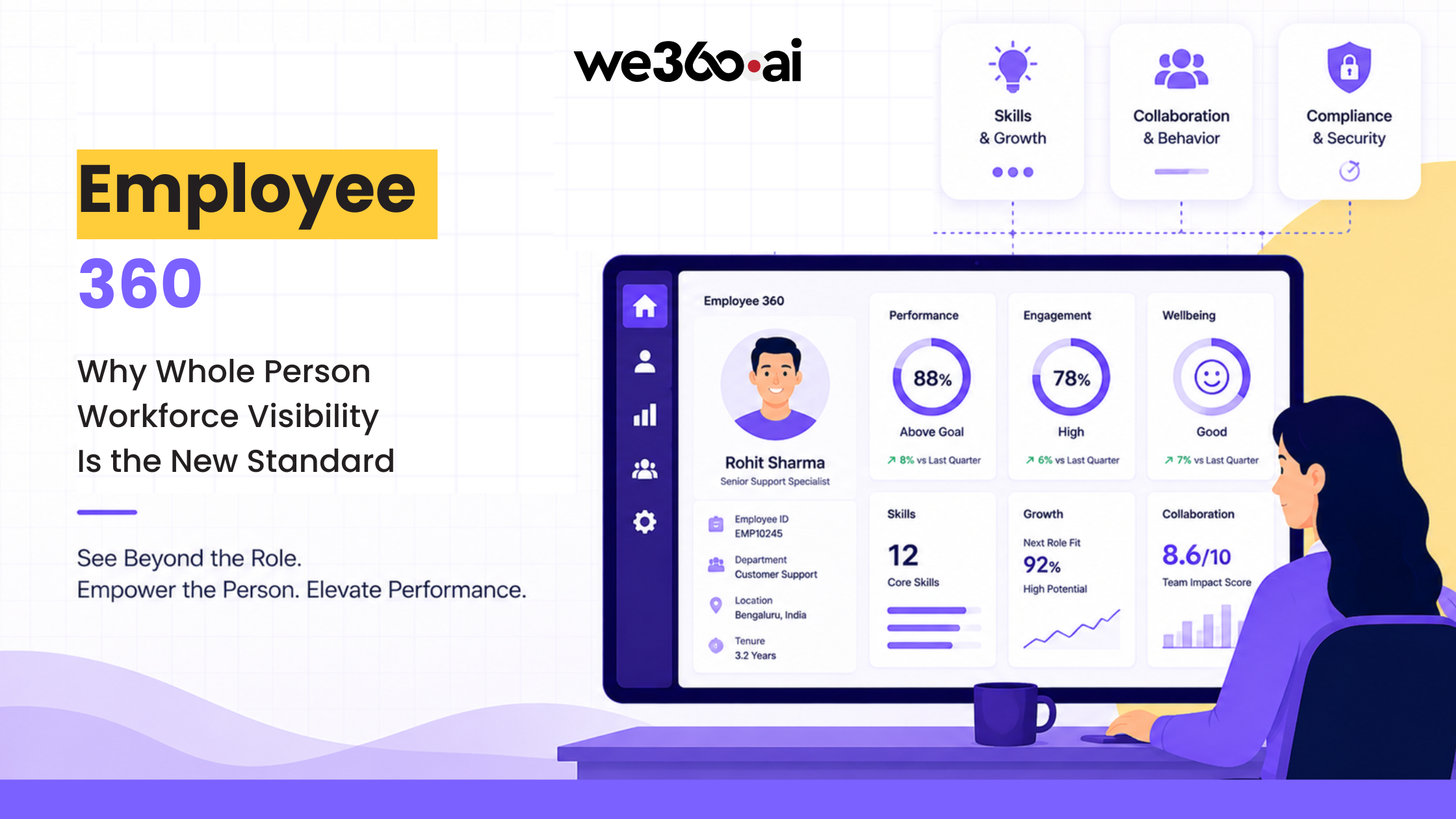
An employee 360 is a unified data profile for each worker that combines attendance, performance, engagement, and learning signals into a single view, instead of leaving that information scattered across separate systems. It's not one piece of software. It's a data model that different tools feed into.
What is a data model? A data model is a structured way of organizing information so different systems can talk to each other, in this case, so an employee's attendance record and their engagement score can sit on the same profile instead of living in unrelated dashboards.
HR teams and managers use an employee 360 to spot patterns, an attendance drop paired with a falling engagement score, before they turn into a resignation. Most companies start with just two data sources, usually attendance and performance, and add the rest once those two are clean.
What Data goes into the Profile?
This kind of profile typically pulls from five layers: attendance and time, performance, engagement, learning and development, and compensation and tenure. Not every company needs all five on day one, and starting with fewer, cleaner sources beats connecting everything at once.
- Attendance and time. Clock-in patterns, shift adherence, leave trends.
- Performance. Output metrics, OKR progress, manager ratings, peer feedback.
- Engagement. Pulse survey scores, eNPS, participation in optional programs.
- Learning and development. Course completions, certifications, skill gap data.
- Compensation and tenure. Salary band position, time in role, promotion history.
Remote and hybrid work broke the informal visibility managers used to have in a physical office. When you can't see who's struggling by walking past their desk, you rely on data instead, and this kind of profile is what makes that data usable rather than scattered across five logins.
How do you choose the right platform?
Choosing a platform comes down to three categories: full HRIS platforms with built-in analytics, dedicated people-analytics layers, and workforce monitoring tools that feed a 360 view from attendance and productivity data upward. The market splits roughly along those lines, with tools like Darwinbox and Keka covering the first category and Visier covering the second.
Look for four things before you commit: data connectors that work with your existing payroll and HRIS setup without a lengthy integration project, access controls that keep a manager's view limited to their own team, mobile access if you manage BPO or field staff, and an audit trail that logs every access event.
Pricing in India typically breaks into three bands. Starter tools with basic dashboards run ₹200 to ₹400 per user per month. Mid-range platforms with analytics and integrations run ₹500 to ₹900. Enterprise contracts with custom data pipelines are negotiated, usually above ₹1,000 per user per month. We360.ai starts at ₹299 per user per month and covers the attendance, productivity, and data feeds most Indian SMBs need without an enterprise price tag.
How do you build an Employee 360 in 90 days?
Building one follows a three-stage timeline: audit your data sources in week one, connect and clean the first two layers in month one, then add performance and engagement in quarter one. Trying to connect everything on day one is the most common reason rollouts stall.
Week 1: audit your data sources. List every system holding employee data, typically an HRIS like Keka, Darwinbox, or SAP, plus an attendance tool, a performance management system, and an LMS. Note which ones have APIs and which only export CSVs.
Month 1: connect and clean. Integrate attendance and HRIS data first. Standardize employee IDs across every system, since mismatched IDs are the single most common reason a 360 rollout breaks. Set up role-based access so HR sees everything and managers see only their own team.
Quarter 1: add performance and engagement. Pull performance scores and OKR data from your current review cycle, run a first pulse survey, and bring the results into the profile. Build your first at-risk report by flagging employees with declining attendance, low engagement, and no learning activity in the past 90 days.
What compliance rules apply?
Any system that centralizes this much employee data has to comply with India's Digital Personal Data Protection Act, 2023, and with GDPR for any company with employees or customers in the EU. The DPDP Act received presidential assent on August 11, 2023, though its Data Protection Board provisions and final rules were still being phased in as of late 2025, according to the official Act text published by India's Ministry of Electronics and Information Technology.
What is data minimization? Data minimization means collecting only the employee data you actually need for a stated purpose, not everything a system happens to make available.
Three practical requirements follow from that: employees must be told what data gets collected and who can access it, you can only collect what serves the stated purpose, and employees have a right to see their own profile data on request. GDPR reaches further than most Indian companies expect too. Article 3's extraterritorial scope applies to any company processing the personal data of people in the EU, regardless of where the company itself is based, per the official GDPR text.
Before launch, publish an internal data policy naming every source feeding the profile, get HR legal sign-off on scope, and build an employee-facing view so people can see their own data. That last step alone cuts most of the grievances a 360 rollout would otherwise generate.
How do you get manager buy-in?
Manager buy-in depends more on framing than features. Teams that train managers on why the system exists, to support better conversations, not to monitor people, adopt faster than teams that lead with a feature list. Start with one use case, usually appraisal prep, since it's the easiest entry point for skeptical managers.
What tends to fail: launching every data source at once, and describing the rollout internally as a performance management tool rather than a decision-support one. Track manager adoption specifically, not just how many employees are covered. Coverage without manager engagement just means a dashboard nobody opens.
What ROI can you expect?
Companies typically see ROI first in appraisal cycle time and manager admin hours, based on We360.ai customer implementations across Indian industries. One IT services firm with 600 employees in Bengaluru cut its appraisal cycle from 11 working days to 4 after connecting HRIS, attendance, and performance data into one view, and HR admin hours on that cycle fell by 62%.
A 300-seat BPO in Hyderabad found that agents with three or more unplanned absences in a 30-day window had roughly a 70% chance of resigning within 60 days, a pattern that was invisible in an attendance-only system. Combining attendance and engagement data let HR start conversations early and cut voluntary attrition by 18% over two quarters. A 1,200-employee financial services company in Mumbai used full access logging to cut audit preparation time from two weeks to three days.
These are We360.ai customer results, not third-party research, so treat them as directional rather than a guaranteed outcome for every company.
What are the most common mistakes?
The most common mistake is connecting too many data sources at once instead of proving value with two clean ones first. Dirty employee IDs across systems, no employee-facing view, and describing the tool as surveillance in internal communications are the other repeat offenders.
- Dirty employee IDs. Standardize before you build, not after.
- Too many metrics at once. Start with two data dimensions and expand.
- No employee-facing view. Creates suspicion and drives HR complaints.
- Calling it surveillance internally. Kills adoption faster than any technical problem.
- Ignoring mobile. Desktop-only tools go unused by field and floor managers.
Where is employee 360 technology headed?
Employee 360 platforms in 2026 are layering predictive models on top of the same five data layers, rather than adding new categories of data. Predictive attrition models trained on historical 360 data can flag at-risk employees 60 to 90 days before resignation, and skill-gap detection compares current certifications against project pipeline demand.
[Image: A simple funnel showing five workforce data layers feeding into a predictive at-risk score - alt='employee 360 data layers feeding a predictive attrition model']
For BPOs specifically, folding average handle time data into the 360 profile is where Indian-focused tools are pulling ahead of generic global platforms. For IT services firms, project allocation history and billable hours are the next data layer worth adding.
How We360.ai fits into the picture
We360.ai feeds the attendance, productivity, and time-tracking layer most Indian companies need first, and it's built to hand that data off cleanly to whatever HRIS or analytics layer sits on top. That's usually the fastest path to a working profile without a full enterprise platform migration. If you're already tracking burnout signals or working on reducing attrition, the data you need is likely already sitting in We360.ai's dashboard.
We360.ai is SOC 2 Type II and ISO 27001-aligned, which matters directly here since centralizing this much personal data in one place raises the stakes beyond any single source system on its own.
Ready to see your own team's data in one view? Start Free Trial and connect your first data source this week, or book a demo if you'd rather walk through it with our team. Full pricing starts at ₹299 per user per month, and you can see how it fits alongside a wider workforce analytics rollout.
What is an employee 360? A: +−
An employee 360 is a unified profile that combines attendance, performance, engagement, and learning data into one view per employee. HR teams and managers use it to spot patterns like attendance drops paired with falling engagement before they become resignations, usually starting with two data sources and expanding.
What's the best workforce management software for Indian companies? +−
The shortlist typically includes We360.ai for attendance and productivity tracking, Darwinbox and Keka for full HRIS coverage, and Zoho People for smaller teams. The right choice depends on company size, existing data sources, and whether you need real-time productivity data or just HR records management.
Is there a mobile app for employee 360 tracking? +−
Yes, in different forms. EMP360 by Techsophy is listed on the Google Play Store as a separate HR app. We360.ai offers a mobile-responsive manager dashboard and a desktop agent for employee clock-ins, which works through any browser without a dedicated app install.
What's a real HR framework similar to the "7 C's" people mention? +−
The well-documented version is the Harvard Framework of HRM, developed by Michael Beer and colleagues in 1984, built around 4 C's: commitment, congruence, competence, and cost-effectiveness. A unified employee profile supports several of these directly, particularly competence through learning data and congruence through goal alignment.
How long does it take to implement an employee 360 system? +−
Most mid-size companies with digital data sources already in place can stand up a basic version in 4 to 6 weeks, starting with attendance and performance. Adding engagement and learning data typically happens in the following quarter, once the first two sources are clean.
Related Posts
A well-designed employee engagement survey can reveal what employees really think about their roles, managers, recognition, growth, and workplace culture. This guide explains what to ask, how often to survey employees, how to improve response rates, and how to turn survey results into meaningful workplace action.

Toxic workplaces rarely become unhealthy overnight. They develop through patterns of poor communication, favoritism, constant blame, unresolved conflict, and fear of speaking up. In this guide, discover the 10 key signs of a toxic workplace, how to spot subtle red flags like gaslighting and workplace cliques, and practical ways to address them.
Employee burnout often shows up in behavior before employees talk about it. Rising overtime, slower responses, more mistakes, reduced participation, and withdrawal can all be early warning signs. This guide covers the key signs of employee burnout, what causes it, and how managers can spot and address burnout before it affects productivity and retention.
High employee turnover can quickly impact productivity, costs, and team stability but what actually counts as “too much”? This guide explains how to measure turnover, identify the warning signs, understand why employees leave, and use workforce analytics to spot retention risks before they become resignations